
👋 Hi, I'm Arshia
I'm a computational scientist and Chemical Engineering PhD candidate at the University of Waterloo. I build scientific software, high-order numerical methods, and physically rigorous multiphysics models. My work spans solver architecture, bound-preserving algorithms, adaptive methods, automated testing, HPC simulation, verification, experimental validation, and applied CFD.
Selected Projects
Euler–Euler and Turbulence Capabilities for OpenCMP
Developed an H(div)-conforming DG two-fluid solver, a high-Reynolds-number k–ε RANS model with wall functions, and bound-preserving high-order DG limiters. Contributions include engineering-correlation inlet defaults, tutorials, and automated tests.
View OpenCMPDiscontinuous Galerkin Solver for Cahn–Hilliard Navier–Stokes System
DG finite element solver for the coupled Cahn–Hilliard Navier–Stokes (CHNS) system, simulating the evolution of two immiscible, incompressible fluids separated by a diffuse interface, implemented in Python using NGSolve.
View ProjectDiscontinuous Galerkin Solver for Euler–Euler Two-Fluid Model
High-order finite-element DG implementation of a mathematically well-posed canonical two-fluid model with enhanced physical fidelity. Couples phase momentum and volume-fraction transport using mixed H(div)/L2 spaces, bound-preserving schemes, and adaptive implicit time stepping.
Discontinuous Galerkin Solver for Cahn–Hilliard Equation
DG-based finite element solver for the Cahn–Hilliard phase-field equation, capturing spinodal decomposition dynamics of binary fluid systems, with adaptive mesh refinement driven by a Zienkiewicz–Zhu gradient-recovery error estimator on ∇c.
View Project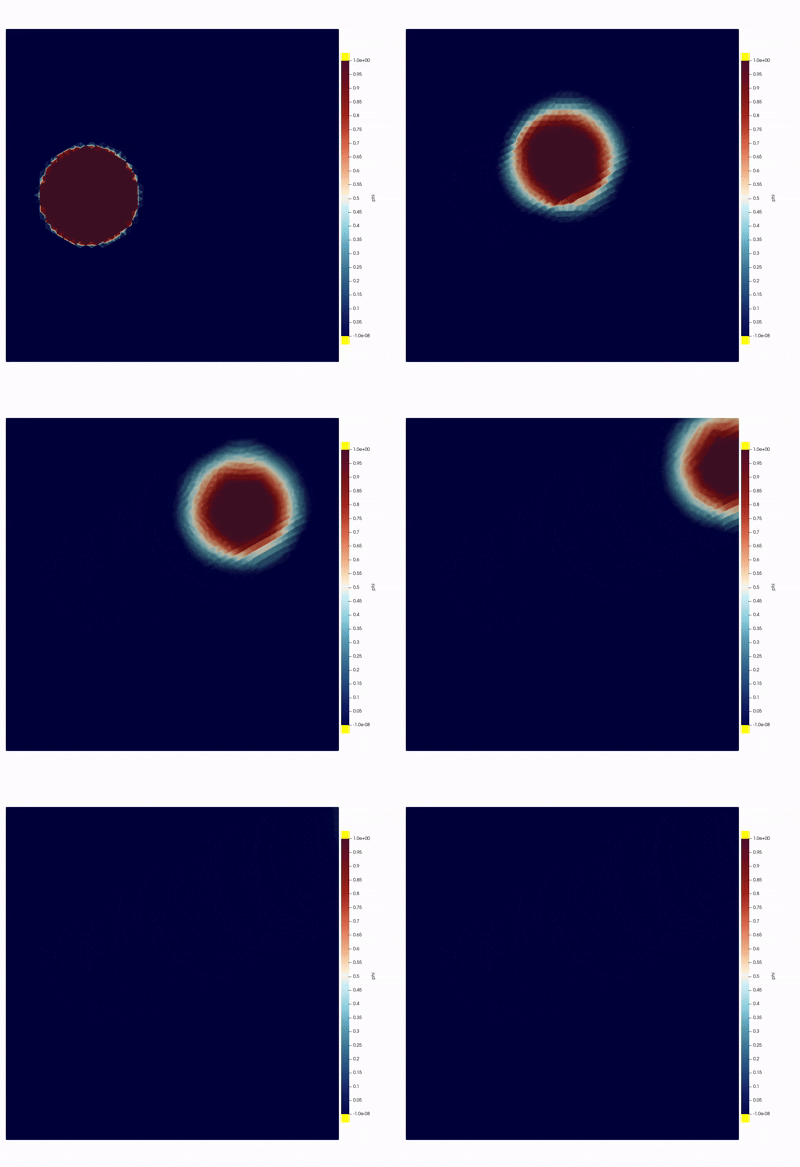
DG Slope Limiters for High-Order Schemes
Slope limiters for high-order discontinuous Galerkin (DG) schemes on triangular and tetrahedral meshes, implemented in NGSolve. Implements Barth–Jespersen, Venkatakrishnan, and Kuzmin vertex-based limiters to suppress spurious oscillations near steep gradients while preserving cell conservation.
View ProjectRecycle-Cup Gas–Liquid Separation for Bitumen Hydroprocessing
Recreated a three-dimensional pilot-scale ebullated-bed reactor to assess gas entrainment in an internal recycle line. Implemented feedback-controlled recycle-outlet conditions and a population balance to study bubble-size effects on gas hold-up, interphase momentum exchange, and hydrodynamics.
Industrial-Scale Aerated Bioreactor
Modelled a 2.08 m diameter, 7.55 m tall vessel with four six-blade impellers using Euler–Euler/PIMPLE, k–ε and bubble-induced turbulence, and multiple reference frames at 120 rpm. Evaluated liquid circulation and gas-volume-fraction distributions throughout the vessel.
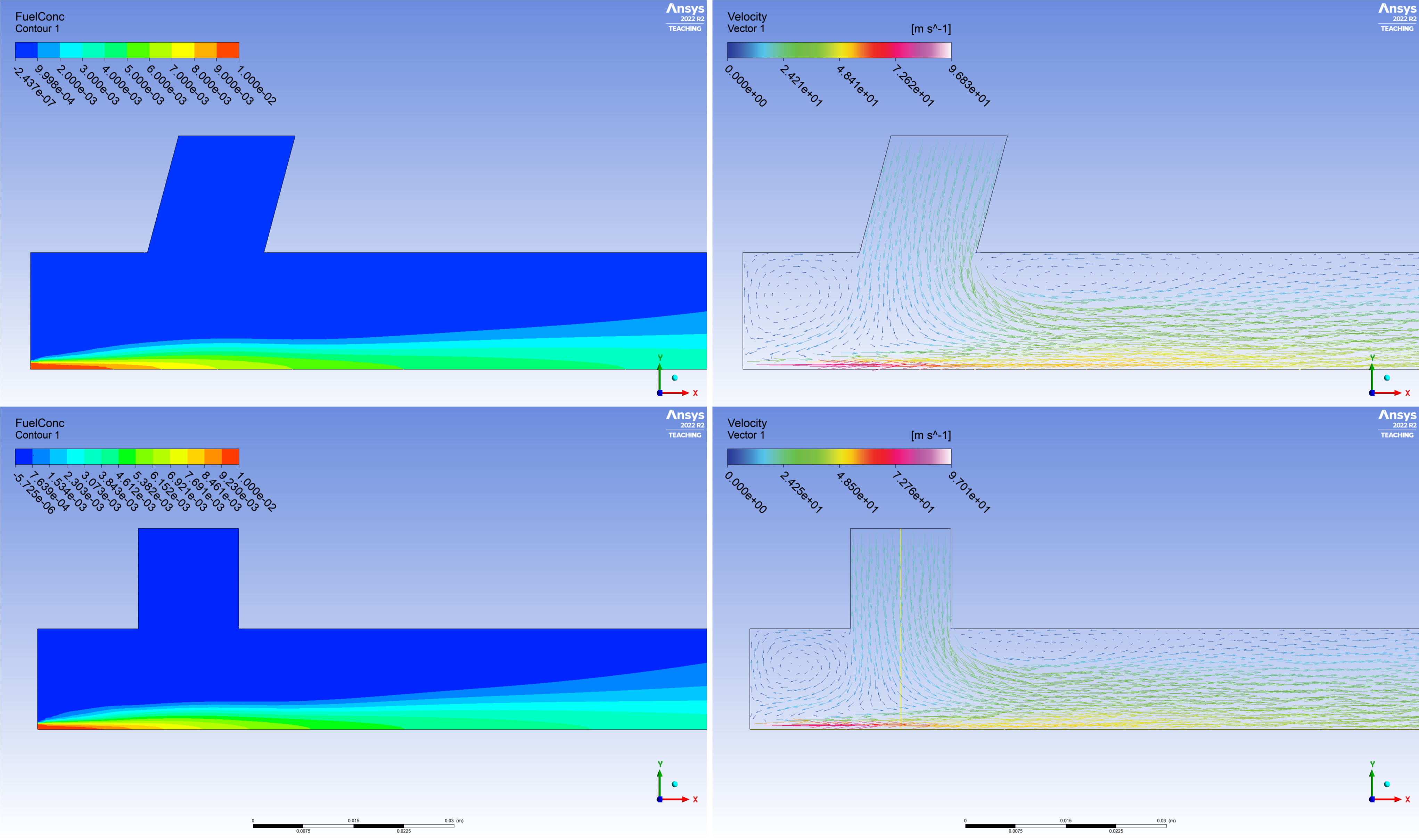
Side-Dump Combustor with Variable Inlet Angles
Simulated turbulent airflow and mixing using Ansys CFX, validated velocity and turbulence predictions against experiments, and performed systematic mesh refinement to distinguish discretization and modelling errors.
1D Euler Equations Solver using Flux Vector Splitting
Finite-volume method solver for the 1D compressible Euler equations using Steger-Warming and Van Leer flux vector splitting schemes. Includes symbolic derivations and shock tube visualizations.
View Project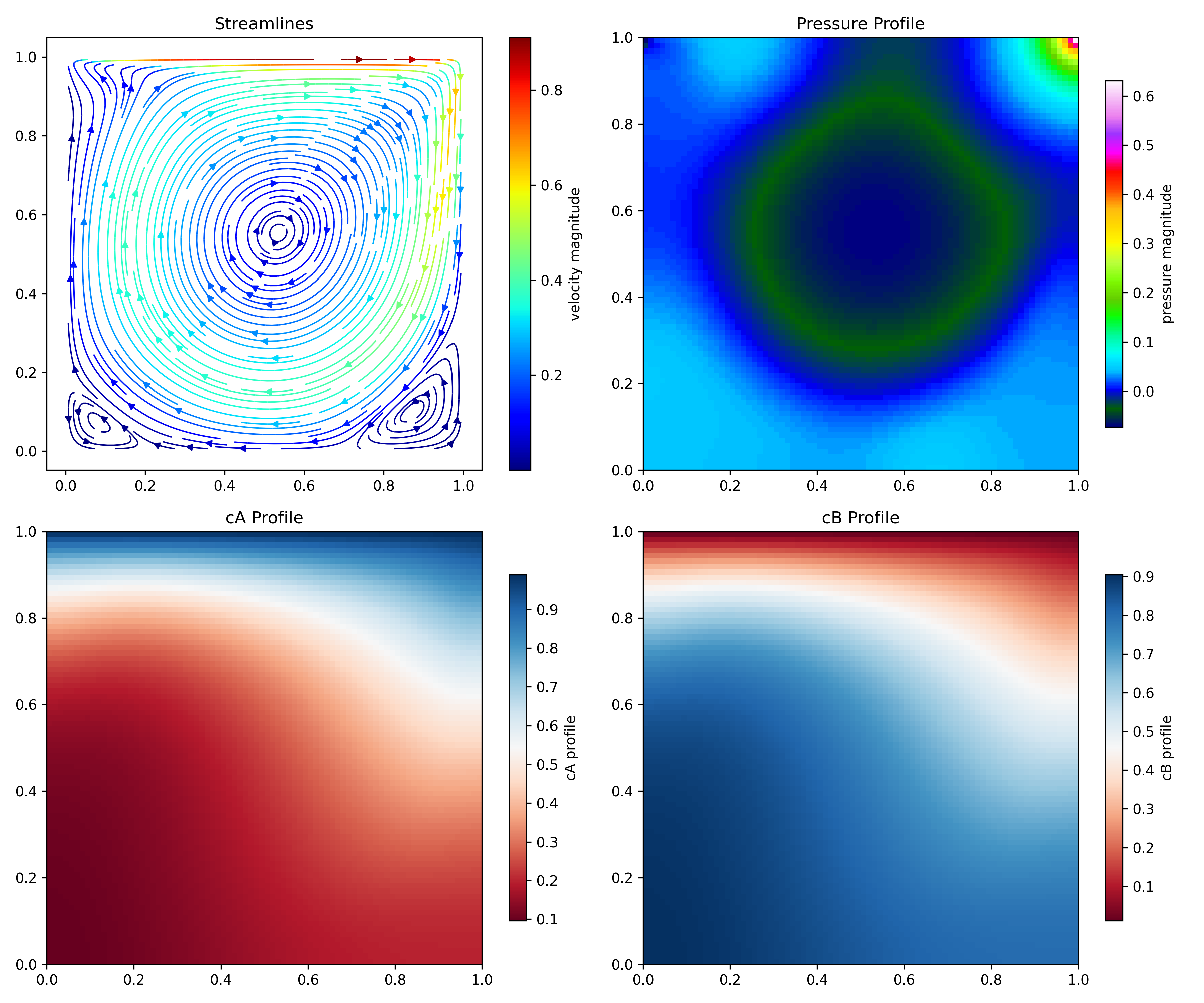
Steady Incompressible Navier-Stokes Solvers with Scalar Transport and Reaction Using SIMPLE Algorithm
Finite-volume method solvers for the 2D incompressible Navier–Stokes equations using SIMPLE for velocity–pressure coupling, extended to include scalar transport and reaction source terms with Numba JIT compilation.
View Project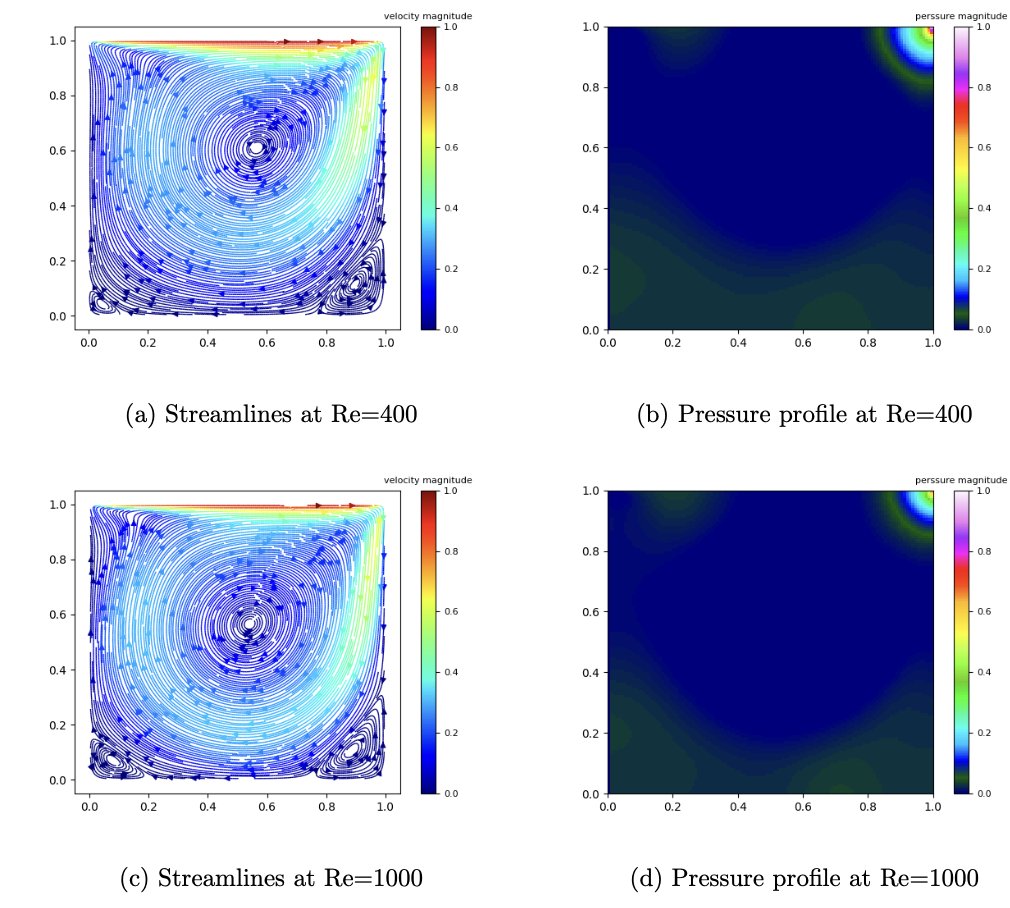
Incompressible Navier-Stokes Solver using SCGS Algorithm
Finite-volume method solver for the 2D incompressible Navier-Stokes equations implemented using the Symmetric Coupled Gauss–Seidel (SCGS) method.
View ProjectPhD in Chemical Engineering
University of Waterloo, ON, Canada
Grade: 92.67 | Key Courses: Advanced Engineering Mathematics, Computational Fluid Dynamics, Multiphase Flow Dynamics, Consulting
BEng in Chemical Engineering
University College London, UK
Grade: First-Class Honours |
Minors: Programming, Manufacture of Regenerative Medicine Products
Key Courses: Computational Modelling and Analysis, Reaction Engineering,
Process Dynamics and Control, Particulate Systems and Separation Processes
Developer — OpenCMP
Open-Source CFD and Multiphysics Framework
- Developed an H(div)-conforming DG Euler–Euler solver with coupled phase velocities, pressure, volume fraction, and selectable interphase-force closures.
- Implemented high-Reynolds-number k–ε RANS with wall functions, automatic wall distance, physical limiters, and correlation-based inlet conditions.
- Added bound-preserving high-order DG limiters, documented tutorials, automated tests, restart support, and CI improvements.
Computational Multiphysics Researcher
University of Waterloo, ON, Canada
- Developed a mathematically well-posed canonical two-fluid model with enhanced physical fidelity, eliminating the mesh-dependent instability of conventional formulations.
- Designed a high-order finite-element DG solver with bound-preserving schemes, coupled phase transport, interphase-force and turbulence closures, and adaptive implicit time stepping.
- Verified accuracy with manufactured solutions and validated 3D gas–liquid and liquid–liquid predictions against three independent experimental datasets on national HPC clusters.
Teaching Assistant
University of Waterloo, ON, Canada
- Teaching Assistant for courses related to transport phenomena, numerical methods for solving ODEs and PDEs, and computational methods.
- Courses: Computer Literacy & Programming (NE111/CHE120), Introduction to Computational Methods (NE113), Continuum Mechanics for Nanotechnology Engineering (NE 318), Theory and Application of Transport Phenomena (CHE601).
- Built a randomized Python autograder for CHE120 with unit testing, safe execution, weighted scoring, and targeted student feedback.
Canonical formulation of two-fluid model with enhanced physical fidelity
A simulation-based study comparing the Classical TFM (C-TFM) and Brennen's TFM (B-TFM) for dispersed liquid–liquid flows. The C-TFM retains dispersed-phase molecular flux terms (∇·(αd πd)) that are physically unjustified for disconnected dispersed-phase sub-domains; the B-TFM, derived from a control volume that avoids cutting dispersed interfaces, naturally excludes them. A scaling analysis demonstrates that the distinction is quantitatively significant for liquid–liquid systems (μd ~ μc), and DG-FEM solvers for both formulations are validated against the Rodriguez et al. (2012) oil-in-water pipe flow experiment.
📄 View PreprintLaminar dispersion force effects on two-fluid modelling and simulation of bubble column hydrodynamics
A simulation-based study investigating the effects of recently proposed laminar dispersion force models on the numerical stability and physical fidelity of the Two-Fluid Model (TFM) for gas-dispersed multiphase flows. Demonstrates that including the laminar dispersion force simultaneously improves hyperbolicity and predictive accuracy, validated against the Pfleger et al. (1999) bubble column experiment using a custom Discontinuous Galerkin FEM solver built with NGSolve.
📄 View Paper